Australians are gathering at Indigenous-led rallies across the country, calling for the date of Australia Day to be changed as a sign of respect towards First Nations people.
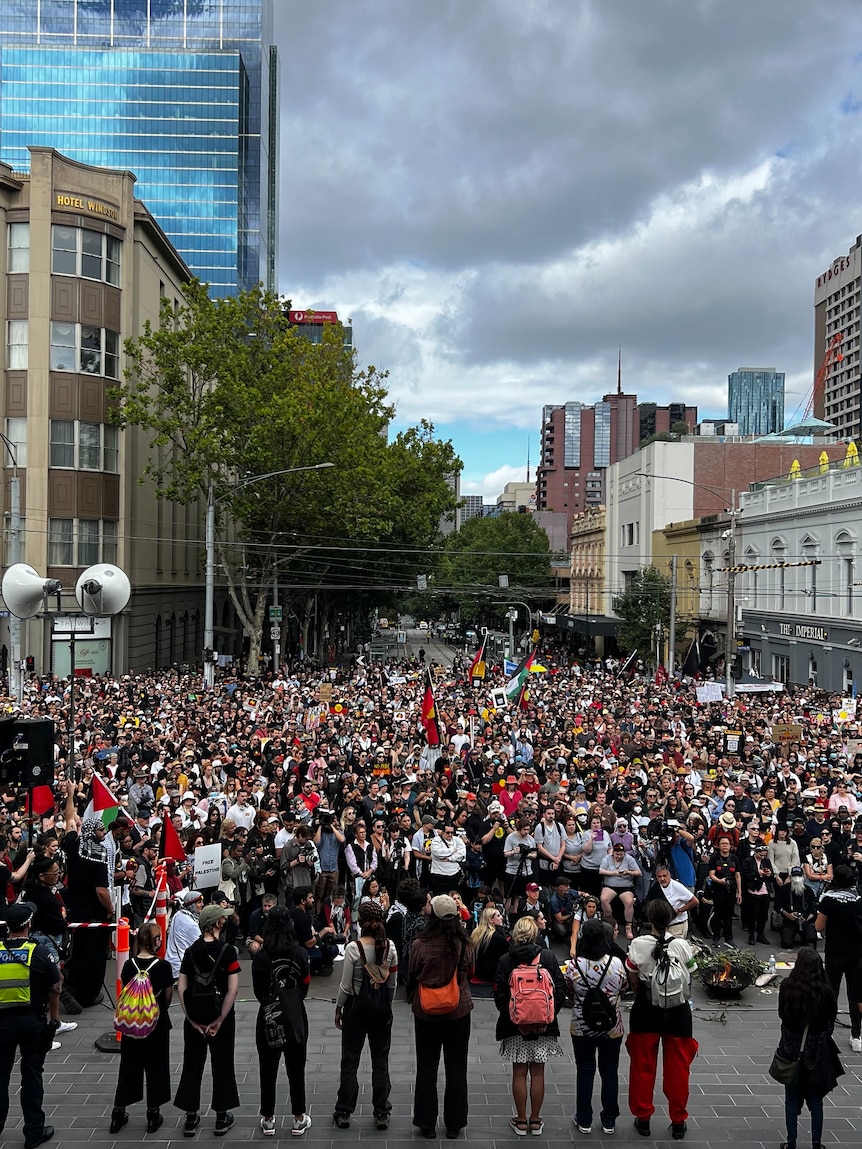
Thousands of people gathered at State Parliament in Melbourne, calling for a day of mourning to be officially declared across Australia.
There was a large turnout of Palestinian supporters after they were formally invited by organisers in a show of solidarity against the war in Gaza.
Speakers called for Australia Day to be changed to a date that reflected the diversity of the nation’s population.
Call for ‘peace, unity’ at Indigenous-led dawn services
Earlier, hundreds of people attended dawn services being held to mark January 26.
As dawn broke over Port Phillip Bay in Melbourne, the sounds of a digeridoo heralded the We-Akon Dilinja, or mourning reflection ceremony.
“Basically if you break it down it means peace, unity and coming together, and acknowledging the past so we can move forward,” Boon Wurrung and Wamba Wemba elder Jason Briggs said.
He said the service was part of the healing process for First Nations people and it carried a message of unity, not division.
“We’ve got to look forward to a pathway that takes us and brings us to a place where we can engage in a better dialogue about resolving issues, differences, reconciling outstanding matters and say, hey, we’re all in this together, we’re a nation, we’ve got this country, we’re all fellow Australians,” he said.
Boon Wurrung elder Carolyn Briggs told the hundreds gathered that Australia was now host to many people from different nations, and it was important for everyone to understand, appreciate and respect the history and cultures of the First Peoples of the land.
“The struggles to preserve our cultures and traditions began with our ancestors,” she said.
“While many of us have descended from different clans and language groups, our grandparents and our great-grandparents worked together to achieve those outcomes and what we celebrate today.
“They’re the most important things we can learn from the past and, today, it is my hope that we can all take pride in our history and celebrate the strength of our great nations.”
Speaking after the ceremony, Jason Briggs condemned the vandalism of a nearby statue of Captain Cook at St Kilda, which was torn down on the eve of Australia Day.
He described it as outrageous and abhorrent act that overshadowed the message of today’s ceremony.
“The Boon Wurrung community is absolutely disgusted by that act,” Mr Briggs said.
“Those individuals or people involved in it do not speak for us, we do not support what they did.”
He believed there was merit to the discussion about changing Australia Day to another date that was more symbolic and inclusive for all.
“26th of January was just a landing on a beach in 1788, I don’t know if that’s created a nation,” he said.
He suggested Federation Day on January 1, Mabo Day on June 3, or a date during Naidoc Week.
The Australia Day holiday, held on the same date as the First Fleet’s 1788 arrival at Port Jackson in New South Wales, is referred to by many Indigenous communities as Invasion Day or Survival Day.
Debate over the national holiday intensifies each year, with Australian cricketer Pat Cummins the latest high-profile individual to voice support for changing the date.
A time to reflect
Ballarat was one of the first regional councils to host a Survival Day dawn ceremony.
It has been held for five years and organisers estimated about 300 people were on the banks of Lake Wendouree this morning as speakers listed massacres that had occurred in the surrounding area.
Gunditjmara woman Nikki Foy was born and raised on Wadawurrung country in regional Victoria.
She said she attended to honour her ancestors and elders, and to mark a day of mourning for the local Aboriginal community.
“It doesn’t matter what day people call it, it’s just a very solemn day to come and sit in reflection.”
She said it was incredible to see the crowds grow over the five years since it began.
“It’s just been beautiful just seeing mob turn up and our elders turn up and talk about what it means, what this day and what this ceremony means to them.”
Ms Foy said Lake Wendouree was a significant place for her, with the ceremony held across the road from an orphanage where her late mother grew up.
“It’s just a really good way to come together with our Aboriginal community and for our allies to come that stand with us in a place of solace and calm.”
Strong turnout in Adelaide
In South Australia, a smoking ceremony has been held at Elder Park/Tarntanya Wama on the banks of Adelaide’s River Torrens.
A strong crowd gathered in the park for the Mourning in the Morning event, which is an official part of the Australia Day schedule.
Ngarrindjeri and Kaurna elder Uncle Moogy Sumner, who led the ceremony, said the event reflected the conflicting feelings surrounding the day.
“Celebrations for some may not be a celebration for others,” he told ABC Radio.
“Mourning in the Morning – we recognise this day and the pain and suffering that our people went through and are still going through.
“The main thing is listening to the ceremony itself, listening to how people feel.”
Other events in Adelaide include a marine-themed evening light show at the same venue.
Aus Lights on the River will be held in the park from 5:30pm.
Australia Day Council of South Australia CEO Jan Chorley said the display was intended as an “opportunity to reflect on how we can continue to deepen our connection to nature” and as a tribute to Australia’s “extraordinary beauty”.
Ms Chorley said local celebrations would also highlight and celebrate the “incredible diversity” of contemporary Australia.
An Invasion Day rally will take place in Adelaide’s CBD from late morning.
Invasion Day or Survival Day rallies are expected to be held in cities across the country today.
Other Australia Day events planned include flag-raising ceremonies, air force displays and community festivals.
Posted , updated