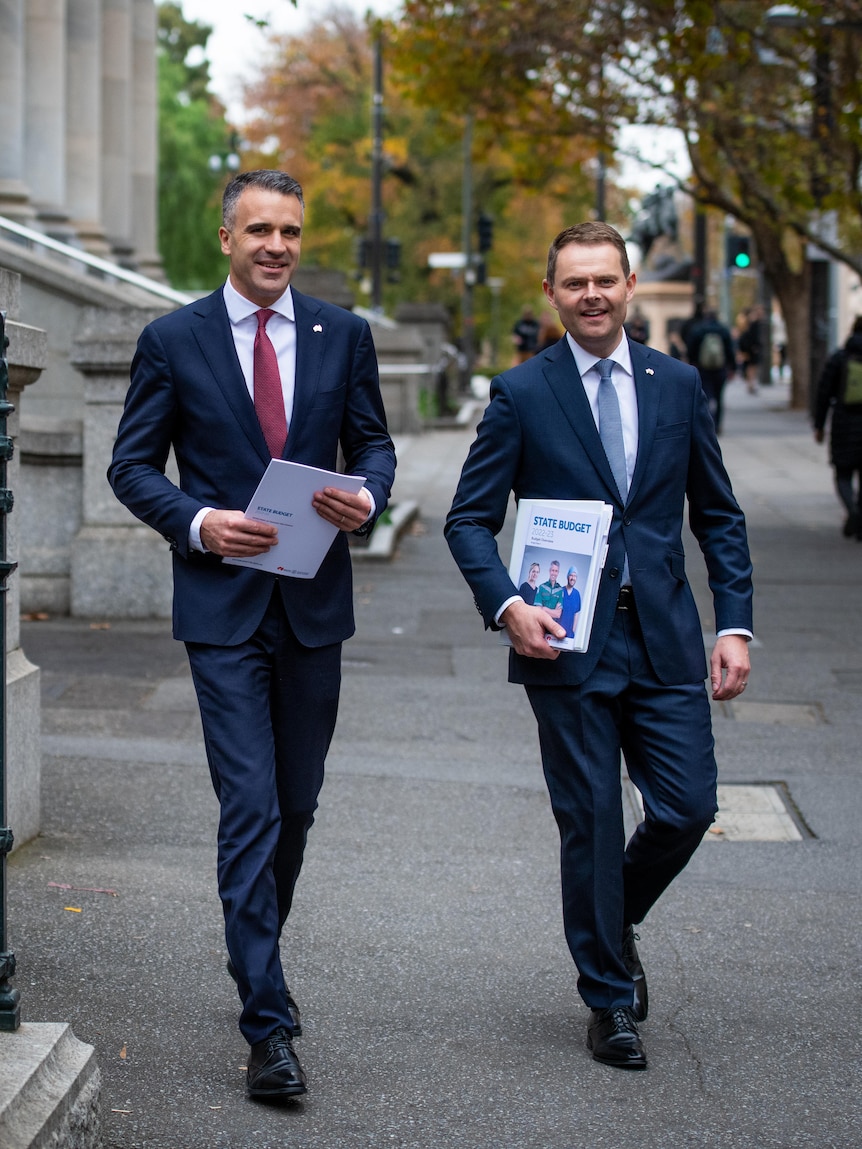
With South Australia’s hospitals stretched and residents struggling to pay rapidly mounting bills, or find anywhere to live, the state’s premier is making no secrets about what his government’s second budget will focus on.
“We’re committed to making sure that health and housing are the bread-and-butter priorities of this government in this year’s state budget,” Peter Malinauskas said.
But tackling health, housing and cost-of-living are not the only challenges for a government which has been hit by a half-a-billion dollar budget blow, plunging the state into the red.
So what can we expect from treasurer Stephen Mullighan’s budget?
What’s in it for me?
Labor has sprinkled out a long list of pre-budget announcements in the lead-up to the big day, with a particular focus on health.
But perhaps the biggest of the biggest of those announcements is focused on helping people with their rising power bills.
Around 420,000 households — and 86,000 small businesses — will get $500 cash payments to help with power bills which are set to go up by more than 20 per cent over the next 12 months.
The scheme, which was announced as part of the federal budget a month ago, is co-funded with the commonwealth and costs state coffers $127 million in the coming financial year.
“This budget has already got locked in the biggest cost of living relief in South Australia,” Mr Malinauskas said.
What else do we know already?
Quite a lot, actually.
As mentioned, there’s been a raft of health announcements already — stretching from upgrades to the existing Women’s and Children’s Hospital to $132 million for four programs specifically designed to try to keep people out of hospitals.
Families of school aged children will benefit from a decision to extend the $100 material and services discount and an additional $20 million has been allocated for upgrades and repairs to public schools across the state.
There’s more cash for roads, including $40 million to upgrade a roundabout in Mount Barker.
To help pay for initiatives, there’s nearly $18 million to upgrade or buy new speed cameras.
Once fully rolled out in just over 12 months’ time, the government expects they’ll bring in an extra $17.1 million a year.
In the environment portfolio, $7.4 million will go next financial year to continue sand carting to West Beach and other Adelaide coastal areas while the government completes the Adelaide Beach Management Review.
The trouble plagued Child Protection Department will have millions of dollars spent on expanding and improving services, like creating a peak body for Aboriginal children and young people and increased family conference services.
So, what’s left to be unveiled?
Health has been the big focus of budget week so far and the power bill package was focused on easing the cost-of-living crunch.
But there is one area the government said would be a major priority that little has been revealed about so far — housing.
Expect to hear more about housing as the government tries to ease a rental crisis and ongoing shortage of homes.
Already this year the government has revealed plans to open up more than 20,000 extra blocks of land in the northern and southern suburbs.
And it says it’s committed to stopping selling off public housing while increasing stocks by 1,100 properties over coming years.
“There is still yet more we can do as a state government and that is a very firm focus,” the premier told reporters earlier this week.
He pointedly went on to mention the challenges which first home buyers are currently facing.
“Whether you’re a person on a public housing waiting list, whether you’re a renter, whether you’re a first home buyer aspirant, these are things that have to be addressed,” Mr Malinauskas said.
“And we are seeking to do as much as we reasonably can within the context of the state budget.”
One other key thing to watch is Tarrkarri, the proposed First Nations art gallery.
Mr Malinauskas warned last month the project could cost as much as $600 million — triple the amount originally budgeted — casting doubt over whether it would go ahead at all.
Where’s the promised surplus?
It’s gone.
From an expected surplus in December in excess of $200 million, in its place is a $249 million deficit for the year which finishes at the end of the month.
It’s a turnaround of nearly half a billion dollars the treasurer blames on additional spending in health, child protection and on the River Murray flood event.
“We’ve made sure that we’re investing funds to look after the community,” Mr Mullighan said.
“While delivering a surplus is important that’ll be something that we’ll aim to do now next financial year.”
Is there anything else to look out for?
It’s no secret that the cost of doing anything is going up.
Case in point, the Adelaide Aquatic Centre project has blown out by $55 million, although an increase in scope is partially to blame for that overrun.
But it has also raised questions about how other major infrastructure projects will be impacted.
“When you get a Labor government in South Australia, you tend to get waste, you tend to get projects being overblown and you tend to get a budget that falls dramatically into the red,” Opposition Leader David Speirs said.
And while more than 400,000 households qualify for the power handout, the opposition argues cost-of-living relief needs to go further with the energy payments extended more broadly than targeting concession holders.
“We know that South Australians are now having to come up with some $20 thousand a year more to cover interest rate rises, inflation across food and fuel and increased energy bills,” Mr Speirs said.
While revenues from key state government sources, like land tax and conveyancing duties, are set to rise, what’s unclear is whether that will last — with an economic slowdown potentially on the horizon.
When asked by ABC News if new commitments would be paid for through increased revenue, or if cuts would be required, the treasurer said people would see “all of that” when the budget is delivered.